Claude Code vs Gemini CLI, One Got Retired
Claude Code vs Gemini CLI after June 18, 2026, when Google cut Gemini CLI off for individual accounts. What replaced it, what still works, what to install.
Claude Code vs Gemini CLI is no longer a live comparison for individual developers. Google stopped Gemini CLI serving Google AI Pro, Ultra and free accounts on June 18, 2026, per its own transition notice, and replaced it with the closed-source Antigravity CLI. Claude Code runs unchanged, included on every paid Claude plan from $20 a month.
Updated September 23, 2026 · by the AITerm team
the day Gemini CLI stopped serving Pro, Ultra and free individual accounts. Enterprise licenses and paid API keys kept working
stars on the Apache 2.0 repository, still public, still committing, and still unable to answer your personal Google account
to pull Gemini CLI out of our own session presets, launch profiles and onboarding docs after the cutoff
Key takeaways
- Google announced the move on May 19, 2026 and cut consumer access on June 18. Enterprise Code Assist licenses, Google Cloud orgs and paid API keys were never cut off.
- The replacement is
agy, the Antigravity CLI binary. It is written in Go and it is closed source, where Gemini CLI was Apache 2.0. - The repository was never archived and carries no deprecation banner, which is why half the internet still thinks the tool is fine.
- The open source license protected the code. It did nothing for the people running the tool, because what got switched off was the service behind it.
- If a tool cannot be swapped out of your workflow in an afternoon, that is a fact about your setup, not about the tool.
Look, we had this article half written as a normal comparison. Latency, tool calling, how each one handles a twelve file refactor, the usual. Then we checked whether the free tier numbers were still current, and the answer turned out to be that the tool is not served to individuals anymore.
Honestly, that reframes the whole question. You cannot benchmark your way to a recommendation between a product you can install today and a product whose consumer authentication path returns a permission error.
Is Gemini CLI still available?
For individual developers, no. On June 18, 2026, Gemini CLI and the Gemini Code Assist IDE extensions stopped serving requests for Google AI Pro, Google AI Ultra and free tier individual accounts. Google announced the transition a month earlier, on May 19, framing it as unifying its agent-first development tools around a single platform.
Access did not end for everyone. Three groups kept it: organizations on a Gemini Code Assist Standard or Enterprise license, organizations using Gemini Code Assist through Google Cloud, and anyone authenticating with a paid Gemini or Gemini Enterprise Agent Platform API key.
So the honest answer depends entirely on how you sign in. That distinction is doing a lot of work, and almost nobody writing about this gets it right.
| How you authenticate | Gemini CLI today | What you do instead |
|---|---|---|
| Personal Google account, free tier | Not served since June 18, 2026 | Antigravity CLI free tier, or a paid API key |
| Google AI Pro or Ultra subscription | Not served since June 18, 2026 | Antigravity CLI, included at no extra cost |
| Gemini Code Assist Standard or Enterprise | Unchanged | Nothing, your access was never in scope |
| Google Cloud org using Code Assist | Unchanged | Nothing |
| Paid Gemini or Agent Platform API key | Works, billed per token | Export GEMINI_API_KEY and carry on |
Here's the thing that makes this genuinely confusing rather than merely annoying. The repository was never archived. google-gemini/gemini-cli is still public, still Apache 2.0, sitting on about 107,100 stars and more than 6,400 commits, and its README carries no deprecation banner at all. Google's notice says it stays available to the community with updates for new models, bugs and security fixes for enterprise customers.
You can clone it. You can build it. It will start. It simply will not answer your personal Google account.
Why the comparison you are reading is stale
Search this exact question today and the first page is mostly articles written before May 19, 2026, still weighing a free tier that no longer exists. We checked the top results while researching this piece. The ranking ones compare context windows and pricing tiers without mentioning that one side stopped serving individual accounts three months ago.
That is not laziness on their part, it is how comparison content ages. A post that ranks for a product question gets refreshed when someone notices the numbers moved, and nobody schedules a refresh for a product being switched off.
Two specific claims keep getting repeated, and both deserve a correction.
The first is the context window argument. Every comparison leads with the million token figure as though it settles the matter. In practice, a larger window changes what you can put in context, not what the agent chooses to read.
We have never once lost a refactor because the window was too small. We have lost several because the agent read the wrong four files. Multi-file editing quality tracks retrieval and tool discipline far more than raw window size, and no comparison we found tested that.
The second is the free tier framing. The old Gemini CLI quota, 1,000 model requests a day with up to 60 requests per minute on Flash, was attached to a personal Google account, not to a project or a team.
A maintainer spelled out in the project's own discussions that a single prompt can trigger dozens of model requests, so "1,000 prompts a day" was never what it meant. For a team of five that quota was five separate personal accounts, which is exactly the arrangement nobody wanted to put in writing.
The community threads have the same problem, and they are worth a word because they rank. Search claude code vs gemini cli on Reddit and the highly upvoted comparisons are from before the announcement, arguing about tool calling and loop behaviour on a tool that was still being served at the time. The technical criticism in them is often sharper than the blog posts. The conclusions are answering a question that closed on June 18.
Trap. If a comparison quotes Gemini CLI's free tier as a current advantage, it was written before May 19, 2026, and you should assume every other number in it is the same age. Check the update date before you trust the pricing table, including ours.
And yes, one more thing people ask constantly: no, Gemini CLI was not based on Claude Code. They are separate implementations from different companies. They look alike because both were built on Ink, the React renderer for terminals, so they redraw and lay out the same way. Shared UI library, not shared lineage.
Claude Code vs Antigravity CLI, the comparison that matters now
The live question is Claude Code against Antigravity CLI, Google's replacement. Antigravity CLI ships as a Go binary called agy, sharing an agent engine with the Antigravity 2.0 desktop application, and Google's notice says Agent Skills, Hooks, Subagents and Extensions carry over, with Extensions becoming Antigravity plugins.
The structural difference is the one worth writing down. Gemini CLI was Apache 2.0 with the source in the open. Its replacement's public repository, google-antigravity/antigravity-cli, distributes installers and releases rather than the source, and sits at roughly 2,400 stars against the 107,100 on the project it replaced.
| Claude Code | Antigravity CLI | Gemini CLI | |
|---|---|---|---|
| Binary | claude | agy | gemini |
| Source | Proprietary | Closed, installers published | Apache 2.0 |
| Written in | TypeScript, Ink | Go | TypeScript, Ink |
| Served to individuals | Yes | Yes | No, since June 18, 2026 |
| Project instructions file | CLAUDE.md, reads AGENTS.md | Migrated from gemini.md | GEMINI.md |
| Other surfaces | VS Code, JetBrains, desktop, web, mobile | Antigravity 2.0 desktop | Code Assist IDE extensions |
| Shipped continuously as | One name since 2025 | Renamed and rewritten in 2026 | Retired for consumers |
Installation is a wash, and the symmetry is almost funny. Both are a single curl line, both drop a binary on your PATH, both authenticate on first run.
# Claude Code, macOS, Linux, WSL
curl -fsSL https://claude.ai/install.sh | bash
cd your-project && claude

# or, if you keep your tooling in Homebrew
brew install --cask claude-code

# Antigravity CLI, macOS and Linux
curl -fsSL https://antigravity.google/cli/install.sh | bash
agy
Where they genuinely differ is posture. Claude Code treats the terminal as the primary surface and spreads outward from it, into VS Code, JetBrains, a desktop app, the web and mobile, all reading the same CLAUDE.md and MCP configuration. It also reads an existing AGENTS.md if your repository already has one for other agents, which matters more than it sounds when you are keeping options open.
Antigravity CLI is the terminal outpost of a platform whose centre of gravity is the Antigravity 2.0 desktop application, and it leans on asynchronous background workflows for long tasks. If that platform is where your team already works, the CLI is a reasonable thing to add. If it is not, you are adopting a platform to get a terminal client.
We cover the wider field, including where Codex sits in this, in our comparison of the AI coding agents.
Can you still run the open-source Gemini CLI?
Yes, with a paid API key, and this is the part almost nobody documents properly. Google's notice preserves access for paid Gemini and Gemini Enterprise Agent Platform API keys, so the npm package plus a GEMINI_API_KEY still gives you a working gemini command. What you give up is the monthly subscription model: you now pay per token.
# the consumer sign-in path is the one that stopped working
# a paid API key is not

npm install -g @google/gemini-cli
export GEMINI_API_KEY="your-paid-key"
gemini

# budget on tokens, not on prompts: a maintainer confirmed in the
# project's own discussions that one prompt can fire dozens of
# model requests
Before you wire a team around that, price it honestly. The free tier was 1,000 model requests a day per personal Google account, and moving to a paid key converts a predictable monthly line item into a usage bill that scales with how chatty your agents are. For a team running agents all day, that is not a small difference.
Community forks exist. Several appeared within weeks of the cutoff, and at least one aims to run the same interface against other providers and local models. Turns out that is the reasonable thing to expect from a codebase with 107,100 stars and hundreds of contributors. It is also early: treat any of them as an experiment, not as the thing you put a five person team on this quarter.
If open source in the terminal is the actual requirement, that is a different search, and we wrote it up separately in OpenCode vs Claude Code.
What this costs per month
Claude Code is included on every paid Claude plan. Pro is $20 a month, or $17 billed annually, and Max starts at $100 with a 20x tier above it. Team and Enterprise seats include it too.
Usage runs on rolling five hour session windows with weekly limits on top. Paid subscribers can switch on usage credits to keep working at standard API rates once the included allowance runs out, which is the lever that matters on a deadline.
Google's side no longer has a Gemini CLI line at all. Antigravity CLI rides on Google AI plan tiers at no extra cost, with an individual free tier built around a weekly agent quota rather than the old daily request count. Those tiers were restructured on the same day as the transition announcement, so check Google's current pricing page rather than any figure you read in an article, this one included.
| What you pay for | Terminal agent included | How the limit is shaped |
|---|---|---|
| Claude Free | No Claude Code | Rolling five hour windows |
| Claude Pro, $20 a month | Claude Code | Five hour windows plus weekly limits, optional usage credits |
| Claude Max, from $100 a month | Claude Code | 5x or 20x Pro per window, higher output limits |
| Google AI plans | Antigravity CLI, no extra cost | Quota windows under a weekly cap, free tier resets weekly |
| Paid Gemini API key | Gemini CLI, still works | Per token, no monthly ceiling to plan against |
Fair question: is $20 a month worth paying when Google gives you a free tier? For a hobby project on weekends, probably not, and we will not pretend otherwise. For anyone whose agent sessions are load bearing on a weekday, the monthly subscription is not the expensive part of the setup. The expensive part is the morning your tooling stops answering and you have not planned for it.
Which terminal agent should you install?
Start from how you work rather than from a benchmark table, because the benchmark lead changes with every model release and your workflow does not. Four cases cover most of the people who ask us.
You were on Gemini CLI free and it stopped
Install Antigravity CLI first, because it is the supported path and your skills, MCP servers and memory files are meant to migrate across. If the weekly agent quota does not carry your week, that is the moment to price Claude Pro rather than the moment to start reading benchmarks.
You maintain one codebase seriously
Claude Code, and it is not close for us. The multi-file loop, the subagents, the permission modes and the instruction file handling are the most mature of the three, and the surfaces around it mean a session you start in the terminal can be finished in an editor or on a phone.
Your org already has Code Assist
Nothing broke for you and nothing needs to change this quarter. Do one thing anyway: find out who signs the license renewal, because your access to the tool now depends on a contract rather than on a public product, and that is worth knowing before renewal season.
You want to stop having this problem
Run two agents, not one, and keep your instructions in a file both can read. Claude Code reads AGENTS.md alongside CLAUDE.md, which makes a portable instruction file a realistic default rather than a purity exercise.
The short version: install Claude Code if your work depends on the session finishing, and keep a second agent configured so that a vendor decision is an inconvenience rather than a week.
The lesson we took from watching a CLI disappear
We got this wrong ourselves, so let us go first. AITerm shipped session presets and launch profiles with Gemini CLI wired in, and our onboarding documentation used it as one of the examples of piloting several agents at once. After June 18 we spent nine days pulling it back out: presets, profile defaults, the docs, the screenshots that showed it running in a pane.
Nine days is not a catastrophe. It is also nine days we spent on a vendor's roadmap decision rather than on our own, and the reason it cost that much is that we had treated an open source license as a stability guarantee.
Which brings us to the position we will actually defend. Apache 2.0 protected the code and did nothing for the people using it. The repository is still there, still permissively licensed, still accepting commits. None of that helped anyone whose gemini command started returning a permission error, because what Google switched off was not the code, it was the service the code talks to.
You're probably thinking that is an argument for self-hosting everything, and it is not. The lesson is narrower and more useful: when a tool's value comes from a hosted model behind it, the license tells you who can fork the client, not who can keep working tomorrow. Read the terms of service with the same attention you give the license file.
Tip. Run the swap drill once, on a quiet afternoon. Pick a real ticket, do it with your second agent instead of your first, and time it. If it takes more than an hour, the friction is in your setup: instructions in a vendor-specific format, MCP servers configured outside version control, or shell aliases nobody else knows about. Fix those three and a vendor announcement stops being a fire drill.
In practice the portable pieces are boring and they are what saves you. An instruction file in plain markdown that more than one agent reads. MCP server definitions committed to the repository rather than living in someone's home directory. A project that builds with one command, so any agent can verify its own work without being told how.
Two agents, two panes, one screen
Everything above assumes the thing we actually build for: you end up running more than one agent, and the second one is your insurance policy. That is not a hypothetical. In our anonymous daily ping, the median is around three simultaneous agent sessions per user, and that number did not go down when one vendor left the consumer market.
Three sessions is already past the point where tab hunting works. An agent waiting for approval looks exactly like an agent that is thinking, unless something on your screen distinguishes them, and the one that finished twenty minutes ago is the one you notice last.
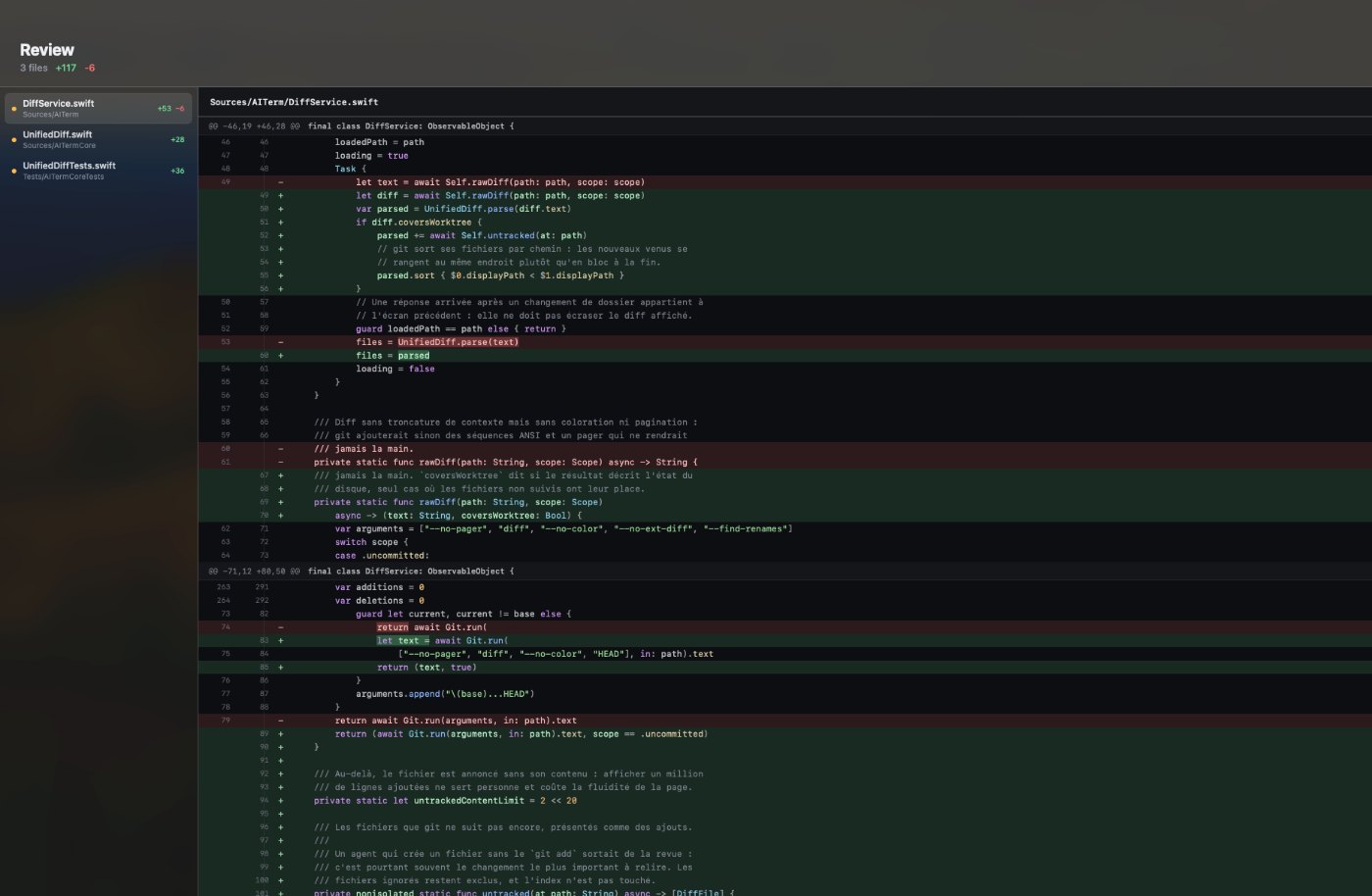
So that is the friction AITerm is built against. Native macOS panes with a live state per agent session, whichever CLI is running inside them, isolated worktrees so two agents do not fight over the same files, and provider quota windows on screen instead of discovered at the worst moment. Twenty panes streaming agent output sit around 140 MB of resident memory on an M2 Air, with keystroke latency under 8 ms, which is the part a web-stack terminal cannot hold once the output gets dense.
The useful property here is that AITerm does not care which agent won your comparison. It runs claude, codex, agy or anything else that draws to a terminal, which means the next time a vendor retires a binary you change one line in a preset. We wrote up the two-agent workflow in detail in Codex vs Claude Code.
Going further
COMPARE
Stop comparing benchmarks
The whole field side by side, and why the benchmark table is the least useful part of the decision.
CODEX
We run both daily
What actually changes when the second agent is a real part of the workflow rather than a backup plan.
OPEN SOURCE
OpenCode vs Claude Code
If the license genuinely is the requirement, this is the comparison to read instead of this one.
PRODUCT
One window, any agent
Live state per agent session in native panes, so swapping a vendor costs one line in a preset.
Sources
- An important update: Transitioning Gemini CLI to Antigravity CLI, google-gemini/gemini-cli discussion #27274, May 2026, the official mirror on Google's own repository of the Google Developers Blog announcement of May 19, 2026: Gemini CLI and the Gemini Code Assist IDE extensions stop serving Google AI Pro, Ultra and free tier users on June 18, 2026; continued access for Gemini Code Assist Standard and Enterprise licenses, Google Cloud organizations, and paid Gemini and Gemini Enterprise Agent Platform API keys; Antigravity CLI built in Go with asynchronous background workflows; Agent Skills, Hooks, Subagents and Extensions carried over as Antigravity plugins; the Apache 2.0 repository remaining available with updates for new models, bugs and security fixes for enterprise customers; and the stated rationale of unifying agent-first development tools on a single platform.
- Important Update: Gemini CLI Has Stopped Serving Requests for Individual Accounts, google-gemini/gemini-cli discussion #28017, June 18, 2026: the cutoff taking effect for Google AI Pro, Ultra and free tier individual accounts while enterprise licenses and API key authentication continue, the
PERMISSION_DENIED (code 403)eligibility error users hit, the platform-specific Antigravity CLI install commands, the claim that skills, MCP servers, agents and memory files migrate automatically, and community reports of lost conversation history, missing features in the replacement and reduced model quotas. - google-gemini/gemini-cli, GitHub repository, consulted September 23, 2026: approximately 107,100 stars, Apache License 2.0, more than 6,400 commits on main, weekly stable releases, and no deprecation or transition notice in the README.
- Clarification on Daily Request Limit, google-gemini/gemini-cli discussion #4122: the free tier quota of 1,000 model requests per day with up to 60 requests per minute on Flash, and the maintainer clarification that a prompt entry does not equate to one model request because a single prompt can trigger dozens of them.
- google-antigravity/antigravity-cli, GitHub repository, consulted September 23, 2026: the
agybinary, install commands for macOS, Linux and Windows, roughly 2,400 stars, a repository distributing installers and releases rather than full source, a terminal interface sharing an agent engine with Antigravity 2.0, and documented multi-step reasoning, multi-file editing, tool calling, persistent history, session export and remote SSH sessions. - Plans and Pricing, Anthropic, consulted September 23, 2026: Claude Code excluded from Free and included on Pro at $20 a month or $17 billed annually, Max from $100 a month with 5x and 20x options, Team and Enterprise seats, rolling five hour session windows with weekly limits, and usage credits at standard API rates once the included allowance is spent.
- Claude Code overview, Claude Code documentation, 2026: the install commands for macOS, Linux, WSL and Windows, the Homebrew and WinGet paths, the terminal, VS Code, JetBrains, desktop and web surfaces sharing one engine and the same CLAUDE.md, settings and MCP servers, and the note that Claude Code can read an existing
AGENTS.mdon its own or alongsideCLAUDE.md. - Our approach to reviewing and merging pull requests, google-gemini/gemini-cli discussion #6900: the project's public contribution process, describing code contributions as the lifeblood of the project, against a reported total of roughly 6,000 merged pull requests from hundreds of community contributors over the project's first year.
Frequently asked questions
Is Gemini CLI deprecated?
For individual developers, effectively yes. Google announced on May 19, 2026 that it was transitioning Gemini CLI into Antigravity CLI, and on June 18, 2026 Gemini CLI stopped serving requests for Google AI Pro, Google AI Ultra and free tier individual accounts, along with the Gemini Code Assist IDE extensions. Access continues for organizations on a Gemini Code Assist Standard or Enterprise license, organizations using Gemini Code Assist through Google Cloud, and anyone authenticating with a paid Gemini or Gemini Enterprise Agent Platform API key. The Apache 2.0 repository itself was not archived: it is still public, still receiving commits, and still carries no deprecation banner in its README, which is the main reason people think nothing changed.
What replaced Gemini CLI?
Antigravity CLI, a Go terminal client whose binary is called agy. Google positions it as the terminal surface of the wider Antigravity platform, sharing an agent engine with the Antigravity 2.0 desktop application. Its public repository, google-antigravity/antigravity-cli, distributes installers and releases rather than the full source, so the replacement is closed source where Gemini CLI was Apache 2.0. Google's transition notice says Agent Skills, Hooks, Subagents and Extensions carry over, with Extensions reimplemented as Antigravity plugins, and that skills, MCP servers, agents and memory files migrate automatically. Install it on macOS or Linux with curl -fsSL https://antigravity.google/cli/install.sh | bash.
Is Claude really better than Gemini for coding?
That framing confuses the model with the harness, and the harness is what changed. Both vendors ship strong coding models, and published benchmark leads move with every release, so any ranking you read is a snapshot. The durable difference in September 2026 is availability and stability of terms: Claude Code has shipped continuously under the same name since 2025 and is included on every paid Claude plan from $20 a month, while Google's terminal client was renamed, rewritten in Go, closed off and cut from consumer plans inside a single month. If you are choosing what to build a workflow on, weigh that record alongside benchmark scores.
Can I still use Gemini CLI with an API key?
Yes, with a paid key. Google's transition notice keeps access for paid Gemini API keys and Gemini Enterprise Agent Platform keys, so installing the npm package and exporting GEMINI_API_KEY still gives you a working Gemini CLI. What you lose is the consumer sign-in path: the free tier that gave 1,000 model requests a day and up to 60 requests per minute on Flash was tied to signing in with a personal Google account, and that path no longer serves requests. You now pay per token instead of per month, and a maintainer clarified in the project's own discussions that one prompt can trigger dozens of model requests, so budget on tokens rather than on prompts.
Which is better, Codex, Claude Code or Gemini CLI?
As of September 2026 that is a two-way choice for individuals, because Gemini CLI is no longer served to consumer accounts. The live options are Claude Code, OpenAI's Codex CLI, and Antigravity CLI as Google's replacement. Claude Code is the most mature terminal loop and the safest default for multi-file work on an existing codebase. Codex CLI is the one to pick if your team already runs on OpenAI billing. Antigravity CLI is worth a trial if you want Google's model quota and asynchronous background workflows, accepting a closed-source client that is younger than the tool it replaced. Most teams we talk to run two, not one.
Does Gemini CLI still have a free tier?
No. The free tier worked by signing in with a personal Google account, which granted 1,000 model requests a day and up to 60 requests per minute with Flash as the default model. That authentication path stopped serving requests on June 18, 2026. Free usage moved to Antigravity CLI, where the individual tier runs on a weekly agent quota rather than a daily request count, so the shape of the limit changed as well as the name. If you want a free quota from Google in the terminal today, Antigravity CLI is the only supported route.
Is Gemini CLI based on Claude Code?
No. They are separate implementations from Google and Anthropic, with no shared codebase. The question comes up because the two terminal interfaces look alike, and there is a real technical reason for that: both were built on Ink, the React renderer for terminal output, so they inherit the same layout behaviour and redraw feel. Gemini CLI is a TypeScript monorepo published under Apache 2.0; Claude Code is proprietary. The resemblance is a shared UI library, not shared lineage.
Should I migrate off Gemini CLI?
If you sign in with a personal Google account, you already have, whether or not you chose to: those requests stopped being served on June 18, 2026. If you authenticate with a paid API key or sit under an enterprise Code Assist license, nothing is forcing your hand today, and the repository is still maintained for those customers. The thing worth doing either way is making the migration cheap in advance. Keep your agent instructions in a file your next tool can read, keep MCP server definitions in version control, and avoid putting anything load bearing in a config format only one vendor parses.