Codex Pricing Is Not the $20 You Think
Codex pricing decoded: the plan grid, what a credit really costs, how to read your usage in the CLI, and what 30 days of Codex on a real repo billed us per shipped change.
Codex has no standalone price. It rides on your ChatGPT plan, from Free through Go at 8 dollars, Plus at 20, Pro at 100 or 200, and Business at 20 per seat. Since April 2, 2026 every plan meters usage in token based credits worth 4 cents each. OpenAI's help centre puts real spend at 100 to 200 dollars per developer per month.
Updated August 28, 2026 · by the AITerm team
what one Codex credit costs, so 25 credits is a dollar and a typical task burns 5 to 45 of them
how much more an output token costs than an input token on the Codex rate card, which decides your bill
how long a 5 hour window survived four Codex sessions running in parallel on our repo
Key takeaways
- The plan grid is the smallest part of your bill. Credits are the rest, and OpenAI says so itself: 100 to 200 dollars per developer per month.
- Output tokens cost about eight times input tokens. You are billed for how long the model thinks, not for how much of your repo it read.
- The unit that actually runs out is the 5 hour window, not the money. It is shared across the CLI, the IDE extension and cloud tasks.
- Parallel agents drain that window roughly as fast as they work. Four sessions took ours from four hours to about seventy minutes.
- Nobody reports cost per shipped change. Ours came out around 16 dollars, which is a very different conversation from the price of the plan.
| Plan | Price | Codex access | Who it is actually for |
|---|---|---|---|
| Free | $0 | Limited | Trying the CLI for an afternoon |
| Go | $8 / mo | Included | Occasional use, one task at a time |
| Plus | $20 / mo | Included | The plan most people mean by "Codex pricing" |
| Pro 5x | $100 / mo | 5x limits | Daily driver, one or two sessions |
| Pro 20x | $200 / mo | 20x limits | Parallel agents, the only tier that survives them |
| Business | $20 / user annual, $25 monthly | Shared credit pool | Teams from two seats up |
| Enterprise / Edu | Custom | Credit pool | Central billing and admin controls |
How much does Codex actually cost per month?
Between 100 and 200 dollars per developer, per OpenAI's own help centre, and that is the number worth planning against. The plan line is 8, 20, 100 or 200 dollars. Credits are what turn that into a real bill, because every plan meters usage in token based credits at 4 cents each since April 2, 2026.
You're probably about to open the pricing page, read the grid, and stop there. That grid is the cover charge. It tells you what you pay to be allowed in, not what an afternoon of agent work removes from your balance.
So, here is the arithmetic that nobody puts on the page. A credit is 4 cents, so 25 credits is a dollar. Morphllm's reading of the OpenAI rate card puts GPT-5.3-Codex at 43.75 credits per million input tokens and 350 per million output, which is 1.75 dollars in and 14 dollars out.
Look at those two numbers next to each other. Reading your codebase is nearly free. Thinking about it is not.
Opinion
Stop trimming your AGENTS.md to save money. At 1.75 dollars per million input tokens, a 6,000 token project file costs about one cent per call, and a good one shortens the reasoning that actually bills you. The advice to keep context lean is real advice about quality. It is terrible advice about cost.
The plans, and what each tier really buys
Every tier buys the same Codex. What changes is how much of it you get before the window closes, and the multipliers are the honest way to read the grid: Pro at 100 dollars is the 5x tier, Pro at 200 is the 20x tier. Business seats are 20 dollars per user on annual billing, 25 on monthly, from two seats up.
In practice, the question is never which plan has the features. It is how many hours per day you actually keep an agent busy. One session on Plus is fine. Two sessions on Plus is a plan that expires by lunch.
And yes, one thing quietly disappeared: pay as you go Codex seats for Business, which billed actual token usage rather than a flat seat. New pay as you go seats stopped being available on June 24, 2026, so credit pools are the model now. If you were planning a variable cost line for a team, that door is closed.
How do you read your Codex usage?
Three surfaces, and they answer different questions, which is exactly why people think the numbers disagree. In the CLI, /status reports window consumption as percentages and /usage reports token totals. Credit balances and exact reset timestamps only exist on the web analytics page.
# how much of the 5 hour and weekly windows you have burned
/status

# token totals, and where you redeem a banked reset
/usage
/usage daily
/usage weekly
/usage cumulative

# put the two window percentages in your prompt line, permanently
/statusline   # opt in to five-hour-limit and weekly-limit
Turns out the /statusline trick is the one worth setting up today. It exposes two opt in items, five-hour-limit and weekly-limit, that sit in your prompt and refresh as you work. That turns a command you forget to run into a number you cannot avoid seeing.
| Where | What it tells you | What it will not tell you |
|---|---|---|
/status | Percentage of the 5 hour window and the weekly cap consumed | When exactly the window resets |
/usage | Token totals by day, week and lifetime, plus reset redemption | Your credit balance in dollars |
| Web analytics page | Credit balance, reset timestamps, cloud task history | Nothing much, but it is a browser tab away from your terminal |
ccusage codex daily | Local log history across days, sessions and other agent CLIs | Your real credit spend, since costs are estimated from public rates |
Look, for anything longer than today, ccusage is the tool. It is MIT licensed, it reads the logs already on your disk, nothing is uploaded, and it covers Codex alongside Claude Code, Gemini CLI and a dozen other agent CLIs. Run it with npx and you get daily, monthly and per session tables in a few seconds.
One more surface most people never find: banked resets. Plus and Pro subscribers each got one complimentary reset when the mechanism launched on June 11, 2026, and you earn more by referring colleagues, up to three during the promotional window. They expire 30 days after they are granted, and you cannot buy them. Check /usage before you assume a dead window means a dead afternoon.
The five hour window is the real unit
Codex meters a rolling 5 hour window with a separate weekly cap stacked on top, and both are tracked independently. The window opens with your first message. Everything inside it counts: your prompts, the files the agent reads, terminal output, cloud tasks, and the model's own reasoning.
Here's the thing. The part that catches people out is the sharing. Local CLI messages, requests from the IDE extension and tasks you delegate to the Codex cloud all draw from one pool. Delegating to the cloud does not buy you a second budget.
Weekly numbers are not published. Every plan table carries a footnote saying weekly limits may apply, with no figure beside it, which is why the community threads are full of people reverse engineering their own caps. OpenAI temporarily removed the 5 hour limit for Plus, Pro and Business on July 12, 2026, then restored it on July 30. That two week reprieve is the reason half the advice you will find online is already wrong.
Honestly, this is the bit we got wrong for a month. We budgeted Codex in dollars, watched the credit balance, and kept getting stopped anyway. The money was fine. The window was not, and the window does not care that you are willing to pay more.
What we paid per shipped change
Thirty days of Codex on the AITerm repository, one Pro 5x seat plus credit top ups, came to roughly 180 dollars. Over that month the agent contributed to 34 merged pull requests, of which 11 became changes that reached a release. That is about 16 dollars per shipped change, and around 5 dollars per merged PR.
The split is the interesting half. Around 70 percent of our credits went to output tokens, roughly 20 percent to fresh input, and the rest to cached input. That is not a quirk of our repo. It is the rate card doing exactly what an 8 to 1 ratio does.
So we spent two weeks doing the wrong optimisation. We trimmed AGENTS.md, cut example blocks, moved reference material out of the project file, and watched the monthly bill move by an amount we could not distinguish from noise. Then we capped reasoning effort on routine tasks and started writing acceptance criteria into the prompt, and the same month's work cost noticeably less.
Here's the thing. A vague prompt does not make the model read more. It makes the model think longer, out loud, at 14 dollars per million tokens.
Four agents empty one window four times faster
Roughly, yes, and we measured it because the brief is the same everywhere and the number is nowhere. One Codex session doing a sustained refactor kept our 5 hour window alive for about four hours. Four sessions on four git worktrees, same repo, same day, hit the cap in about seventy minutes.
So, that changes the correct behaviour, and this is the part no pricing page will ever tell you. On a subscription, running four agents does not buy you four times the throughput. It buys you the same throughput, compressed into a shorter slot, followed by a wall.
The median in our anonymous daily ping is three simultaneous agent sessions per user. Three is a comfortable number on a 20x seat. On Plus it is a way to be finished by 10am.
Fair question: why not stagger them instead? That is exactly what we do now. Two agents on the heavy work, a third on review, and the fourth task queued rather than launched, because a task started at 80 percent window consumption is a task you will restart later with a cold cache.
There is a quieter multiplier hiding in there too. Every session sends its full conversation with each request, so long lived parallel sessions pay the input cost again on every turn. Cheap per token, but four sessions multiply it, and it lands in the same window.
The trap
Cloud tasks feel like free parallelism because they run on someone else's machine. They are not. Local CLI messages, IDE extension requests and cloud tasks share the same 5 hour pool, so offloading three long jobs to the cloud while you keep working locally is the fastest way to hit a cap you did not see coming.
Is Claude Code cheaper than Codex?
Usually not, and the gap is smaller than the loudest threads claim. The subscription tiers match exactly at 20, 100 and 200 dollars, so price differences come entirely from token consumption. Third party measurements published in 2026 put Claude Code at roughly 1.4 times the tokens of Codex on matched tasks, working out near 23 percent higher cost for equivalent work.
And yes, you will also find a widely shared anecdote about one complex refactor costing 155 dollars on Claude Code against 15 on Codex. Treat it as one. A 10x gap on a single task says more about how the two agents were prompted than about the price of either.
In practice, we run both daily, so here is our actual allocation rather than a verdict. Codex takes the long mechanical runs where the brief is already written: migrations, test backfills, dependency work across many files. Claude Code takes anything where we want the agent to push back.
Anthropic doubled the Claude Code 5 hour caps for Pro, Max, Team and seat based Enterprise on May 6, 2026, and dropped the peak hours reduction. The free plan got neither. That single change dated a lot of the cost comparisons still ranking on this query, so if you read one without a date on it, close the tab.
Six habits that cut our Codex bill
Honestly, none of these are clever. All of them survived a month of measurement, which is a lower bar than it sounds and still more than most advice on this topic clears.
Write the acceptance criteria first
The single biggest lever we found. A brief with a testable definition of done shortens the reasoning, and reasoning is the expensive half of the rate card.
Cap reasoning effort on routine work
A dependency bump does not need deep deliberation. Reserve the long thinking for the tasks where you would have argued with a colleague about the approach.
Put the window in your prompt line
Opt in to five-hour-limit and weekly-limit through /statusline. A number you see is a number you manage. A command you have to remember is not.
Start heavy runs at the top of a window
A migration launched at 75 percent consumption gets interrupted and restarted, and the restart pays for the context again from cold.
Queue the fourth agent, do not launch it
Three concurrent sessions is our ceiling on a 5x seat. Past that the window becomes the bottleneck and you are just choosing which task gets killed.
Check for a banked reset before you stop
They expire 30 days after they are granted, and unredeemed ones vanish. Run /usage when you hit a cap instead of closing the laptop.
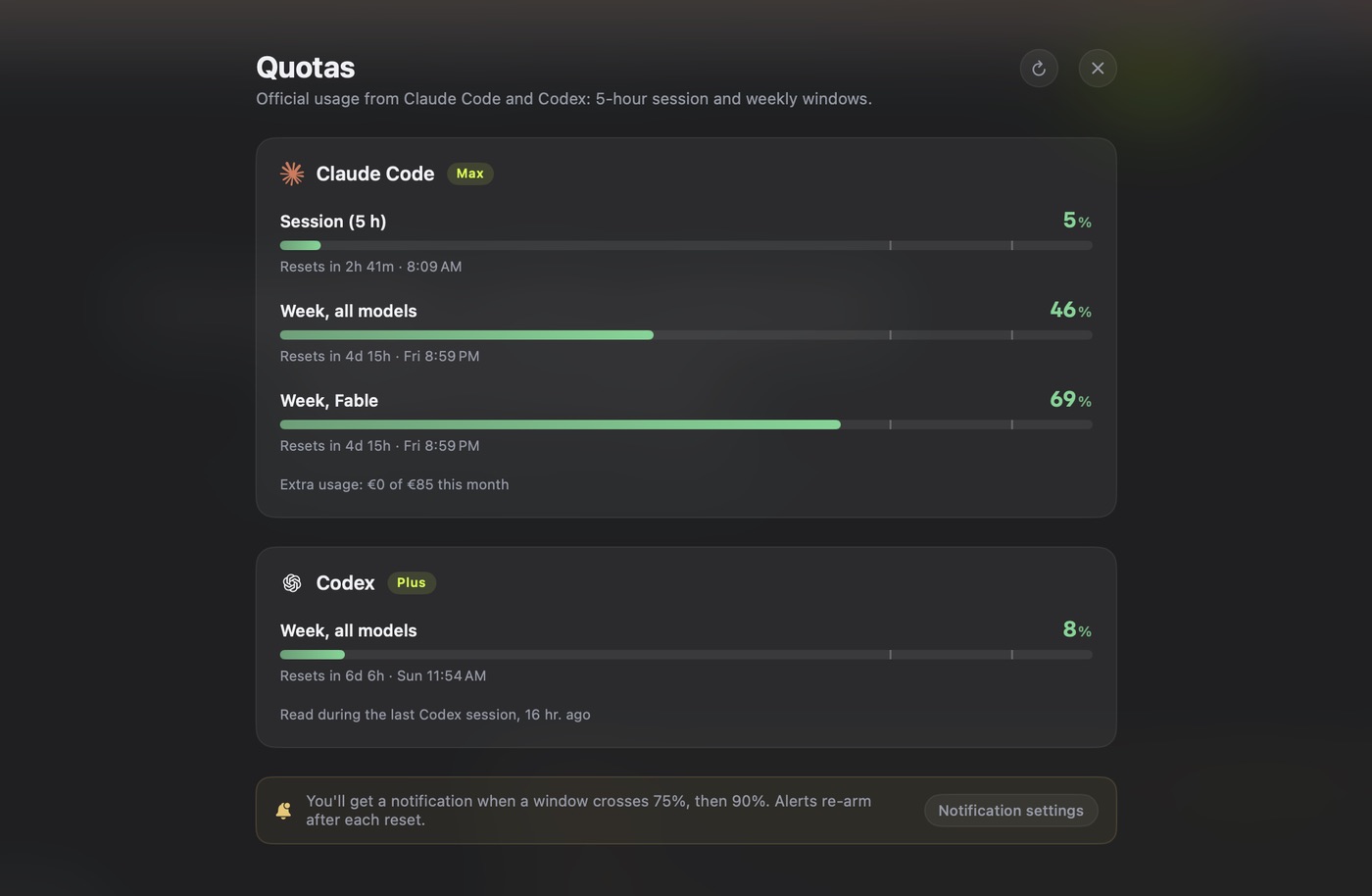
The one we did not put on that list, because it is a product opinion rather than a habit: the window should be visible without typing anything. We built the quota panel in AITerm for exactly this, showing the live 5 hour and weekly state per provider next to each agent session, because the number that stops your afternoon should not live in a browser tab.
The short version: budget 100 to 200 dollars per developer and stop arguing about the 20 dollar line. Optimise output tokens, not context. And measure your own cost per shipped change, because it is the only number that tells you whether any of this is working. That's it.
Going further
PILLAR
The Codex CLI guide
Install, approval modes, AGENTS.md and MCP, everything the pricing page assumes you already know.
COMPARISON
Codex vs Claude Code
We run both daily, on the same tickets, and the split is not the one the benchmarks suggest.
PARALLELISM
Six worktrees, four paid off
The other half of this article: what parallel sessions cost in machine, merge time and attention.
CODEX
Skills that earn their context
Input tokens are cheap, but a skill that shortens the reasoning is where the saving actually is.
PRODUCT
What AITerm costs
One price, no window, no credits. The terminal is not the part that should meter you.
QUOTAS
Every window on one screen
Live 5 hour and weekly state per provider, beside the sessions burning it.
Sources
- Codex Pricing, OpenAI, 2026: the plan grid from Free through Go, Plus, Pro 5x and 20x, Business and Enterprise, and the footnote stating that additional weekly limits may apply without publishing a number.
- ChatGPT Rate Card, OpenAI Help Center, 2026: credit based pricing for Business, Enterprise and Edu, the per model token rates, and the stated 100 to 200 dollars per developer per month figure.
- Codex now offers pay-as-you-go pricing for teams, OpenAI, 2026: the pay as you go seat model for Business, since withdrawn for new seats.
- Codex pricing to align with API token usage, instead of per-message, Hacker News, 2026: the April 2, 2026 switch from message based billing to token aligned credits, and the developer reaction to it.
- Codex Pricing 2026, Morphllm, 2026: the reading of the rate card used here, 43.75 credits per million input tokens and 350 per million output for GPT-5.3-Codex, the 4 cent credit value, the 5 to 45 credit range for a typical task, and the June 24, 2026 end of new pay as you go seats.
- OpenAI Codex pricing in 2026, CloudZero, 2026: plan by plan cost breakdown and the variables that move real spend, namely model choice, concurrent instances and automations.
- Codex 5 hours usage limit feels misleading, OpenAI Developer Community, 2026: the paid user thread documenting how the rolling window behaves in practice and what happens at the cap.
- Rate limit cost per token jumped on the Plus plan, openai/codex issue 28879, 2026: user measurements of window consumption changing under the credit model.
- Show remaining Codex credits in the CLI statusline, openai/codex issue 19555, 2026: confirmation that credit balances and reset timestamps live on the web usage page rather than in the CLI.
- How to Check Your Codex Usage and Rate Limits, SessionWatcher, 2026: the split between what
/statusand/usagereport, the/statuslineopt in items, and the July 12 to July 30, 2026 window during which limits were lifted for Plus, Pro and Business. - ccusage, Codex guide, ryoppippi, 2026: the MIT licensed local CLI that reads agent logs on disk, its Codex support and the
ccusage codex dailycommand, with costs estimated from public rates. - codex-reset, 2026: how banked rate limit resets are granted and redeemed, the June 11, 2026 launch grant for Plus and Pro, the referral mechanism capped at three, and the 30 day expiry.
- Where to find Codex usage limits, r/OpenAI, 2026: the top ranking thread on this query, and the confusion about where the numbers went that this article answers.
- Claude Code Limits, 5 hour caps doubled in May 2026, Verdent, 2026: the May 6, 2026 change to Claude Code limits for Pro, Max, Team and seat based Enterprise, the removal of the peak hours reduction, and the exclusion of the free plan. This is the change that dates most Codex versus Claude Code cost comparisons still ranking today.
- Claude Code vs Codex, 23% higher cost per task, Tech Insider, 2026: the measurement putting Claude Code near 1.4 times the tokens of Codex on matched tasks, and the widely repeated single refactor anecdote treated here as an anecdote rather than a rate.
Frequently asked questions
How much does Codex cost per month?
Codex has no standalone subscription. It rides on your ChatGPT plan: Free at 0 dollars, Go at 8, Plus at 20, Pro at 100 for the 5x tier and 200 for the 20x tier, Business at 20 per user on annual billing and 25 on monthly. Those are entry prices, not what a working developer spends. OpenAI's own help centre puts real usage around 100 to 200 dollars per developer per month once credits are included, and our own 30 days on the AITerm repo landed near 180.
How do you read Codex usage?
Three places, and each one answers a different question. In the CLI, /status shows how much of your 5 hour window and weekly cap you have burned, as percentages. /usage shows token totals with daily, weekly and cumulative views, and it is also where you redeem a banked rate limit reset. Credit balances and exact reset timestamps live only on the web page at chatgpt.com/codex/cloud/settings/analytics. For history across days and machines, the open source ccusage reads your local logs with ccusage codex daily.
What are the Codex usage limits?
Codex meters a 5 hour rolling window with a weekly cap stacked on top, and the two are tracked separately. The window opens with your first message and everything Codex does inside it counts: your prompts, files it reads, terminal output, cloud tasks and the model's own reasoning. The window is shared across the CLI, the IDE extension and cloud tasks, so they all draw from one pool. OpenAI publishes the 5 hour mechanics but not the weekly numbers: every plan table carries a footnote saying weekly limits may apply, with no figure next to it.
What is Codex best used for?
Long, well scoped, mostly mechanical work where you can write the acceptance criteria before you start. Migrations, test backfills, dependency bumps across many files, refactors with a clear before and after. That is also the cheapest shape of work under credit billing, because output tokens cost roughly eight times input tokens: a precise brief produces a short answer, and a vague one produces an expensive essay. Codex is a weaker fit for open ended design work where you argue with the agent for twenty turns.
Is Codex better than ChatGPT?
They are not competing products. Codex is the coding agent inside your ChatGPT plan, so you do not buy one instead of the other. The practical difference is access: Codex reads and writes files in your repository, runs commands and iterates on the result, while a ChatGPT conversation only sees what you paste into it. If your question is which one to bill your work to, the answer is that they share the same window, so a heavy Codex afternoon does eat into the same allowance.
Is Claude better than Codex?
On the bill, Codex is usually the cheaper of the two for equivalent work. Subscription tiers match at 20, 100 and 200 dollars, so the difference is token consumption, and third party measurements in 2026 put Claude Code at roughly 1.4 times the tokens of Codex on matched tasks. We run both daily and pick per task rather than per month: Claude Code for work that needs judgement and pushback, Codex for long mechanical runs where the brief is already written.
Can Codex access my computer?
The Codex CLI runs locally and can read your files and execute commands in the directory you launched it from, within the approval mode you chose. Cloud tasks are different: they run on OpenAI infrastructure against a copy of your repository, not on your laptop. Both draw from the same 5 hour window, which surprises people who assume delegating to the cloud is free. Nothing leaves your machine in local mode beyond the prompts and file contents the agent sends to the model.