Claude Code Review Needs a Second Model
Claude Code review measured on 62 of our own pull requests. What it catches, what it waved through, the local command against the GitHub App, and the second model.
Claude Code reviews code two ways: a local /code-review command that reads your branch before you push, and a managed GitHub App that reviews pull requests with a fleet of agents and posts inline comments by severity. The command is included with Claude Code. The managed service is Team and Enterprise only, at 15 to 25 dollars per review.
Updated September 4, 2026 · by the AITerm team
findings agent review posted across 62 merged pull requests in our repo, over four months
of those were bugs that would have shipped. The other 139 were nits, noise or things we already knew
how often Claude Code and Codex flagged the same thing when we ran both on the same diff
Key takeaways
- Three separate products answer to the name "Claude Code review". Pick the wrong one and you either pay 20 dollars a pull request for nothing, or wait for a service your plan cannot buy.
- Agent review is strong on correctness inside the diff and weak on intent across the repo. Our miss was a four-line change that was correct in isolation and wrong in sequence.
- The default setup has one model writing and the same model reviewing. Research on evaluator self-preference says that is the worst possible pairing, and it costs nothing to fix.
- The check run is deliberately neutral and never blocks a merge. If you want a gate, you parse the severity JSON yourself.
- Two agents in two panes is where review stops being a queue and starts being parallel work.
Here's the tension nobody addresses head on. Code review is the task an agent pays off on fastest, and it is also the task developers trust an agent with least. Stack Overflow's 2025 survey has 84% of developers using or planning to use AI tools, up from 76%, while the share who actively distrust the accuracy of what those tools output climbed from 31% to 46%. Only 3% say they highly trust it. The single biggest complaint, from 66% of respondents, is output that is almost right but not quite.
An almost-right code review is not a small problem. It is a reviewer who approves.
So we did the boring thing and measured it on ourselves, on a real Swift codebase, over four months. Here is what came out.
What does Claude Code review actually catch?
It catches correctness bugs that live inside the diff and the code immediately around it: races, unhandled edge cases, silent failure paths, queries missing a scope. Anthropic reports that under 1% of the managed service's findings get marked incorrect by the engineers reading them. That number is real, and it is also not the number you want.
The number you want is how many of the correct findings mattered. So, our audit: 62 merged pull requests in the AITerm repo between May and August 2026, every one of them run through /code-review at default effort, findings logged whether or not we acted.
One shipping bug prevented every seven pull requests. That is a good trade at the price of a local command and it is a defensible trade at 20 dollars a review, depending on what your bugs cost you. It is nowhere near the "AI reviews your code" pitch, and the honest framing matters, because the gap between the pitch and this number is where teams lose trust in the tool entirely.
The managed service tags each finding at one of three severities. Important is a bug to fix before merging, Nit is minor, Pre-existing is a bug your pull request did not introduce but touched. Our nine live almost entirely in the first bucket, and the volume lives in the second.
Tip. The nit volume is the thing that kills adoption, and it is tunable. A REVIEW.md rule as blunt as "report at most five nits per review, mention the rest as a count in the summary" changes the character of every review after it. Our first month without one was 40% louder for no extra bugs found.
The bug our reviewer waved through
Release 1.6.2. We changed four lines in the onboarding gate, the one that decides whether a user sees the welcome tour. We bumped WelcomeTour.version because the tour had a new step, and the gate compares that version against the stored welcomeTourSeen value.
The review approved it. Correctly, in a sense. The diff was internally consistent, the comparison was right, the version constant was right, nothing in those four lines was wrong.
Turns out the migration that normalizes welcomeTourSeen for users coming from an older build runs after the gate reads it, in a different file, which the diff did not touch. Every user updating from 1.6.1 got the full guided tour again on launch. We found out from a support email, not from CI, not from the reviewer.
Honestly, that one stung, because it is the exact failure class the research predicts. Writing for O'Reilly Radar, the argument is that roughly half of security defects are intent violations: things the code does not do that it was supposed to, or does that it was not supposed to. They are invisible without a specification to check against, and no tool finds them by reading code that is, structurally, perfectly sound.
The same piece points at the NIST SATE evaluations, where the best static analysis tools plateaued around 50 to 60% detection on security vulnerabilities. Agent review moves that ceiling. It does not remove it.
You're probably thinking a longer CLAUDE.md would have caught it. We thought so too. We added the ordering constraint to the onboarding section of ours, and the next review that touched the same file did flag it, at nit severity, buried under eleven other nits. Documenting the trap helps. It does not promote the trap to the top of the list.
Three products wear the same name
Look, this is where most of the confusion around "claude code review" comes from, and it is worth thirty seconds of your time before you set anything up. Three distinct things, three billing models, three levels of control.
| Local /code-review | Managed Code Review | GitHub Action | |
|---|---|---|---|
| Runs where | Your machine, background subagent | Anthropic infrastructure | Your GitHub runner |
| Reviews | Branch commits ahead of upstream plus uncommitted work | The pull request, on open, on push or on demand | Whatever your workflow triggers on |
| Availability | Any plan with Claude Code | Team and Enterprise, research preview | Any plan, you bring the key |
| Cost | Your normal usage | 15 to 25 dollars per review, usage credits | Tokens plus Actions minutes |
| Reads REVIEW.md | No, CLAUDE.md only | Yes | CLAUDE.md, plus whatever you pass |
| Can fix, not just comment | Yes, with --fix | No, comments only | Yes, if you let it push |
The managed service is the one with the fleet: multiple agents analyze the diff in parallel, each looking for a different class of issue, then a verification step checks each candidate against actual code behavior before anything is posted. Findings are deduplicated, ranked, and attached to the lines they concern. Average completion is 20 minutes.
The open-source plugin behind the self-hosted path is less mysterious than the marketing suggests, and you can read it: four parallel agents, two auditing CLAUDE.md compliance, one hunting obvious bugs, one reading git blame for context. Each issue gets a confidence score from 0 to 100, and anything under 80 is dropped. That threshold is a number in a file you can change.
How do you set up Claude Code review?
Start local. It costs nothing extra, it takes one command, and it tells you within a day whether agent review is worth wiring into CI for your codebase. If you are still getting your bearings in a single session, the Claude Code fundamentals come first: review inherits your CLAUDE.md, so a vague memory file produces a vague reviewer.
Review before you push
Type /code-review in the session where you worked. It reads your branch's commits ahead of upstream plus the working tree, runs as a background subagent with its own context window, and drops the findings back into your conversation when it finishes.
Pick an effort level
Low and medium report only high-confidence findings. High through max broaden coverage and let through things the review is less sure about. The level you type is remembered across sessions, so /code-review low today changes what tomorrow's bare command does.
Write REVIEW.md, not a longer CLAUDE.md
For the managed service, REVIEW.md at the repo root reaches the agents that find, verify and rank. It is where severity gets recalibrated, nits capped, generated paths skipped. Keep it short, because length dilutes the rules that matter.
Put it on pull requests
Either an Owner enables the managed service and picks a trigger per repository, or you run /install-github-app, take the review workflow, and own the YAML. The second path works on any plan and bills through your own key.
Decide what blocks a merge
The Claude Code Review check always completes with a neutral conclusion, by design, so branch protection never sees a failure. Gating is your job, and the check run output carries a machine-readable severity count for exactly that.
The local command has three flags worth memorizing. --fix applies the findings to your working tree, --comment posts them as inline comments on the pull request from your own session, and --post handles the cloud variant. And yes, one gotcha: a background review's --fix edits land outside your session checkpoints, so /rewind will not undo them. Use git.
# before you push, cheap pass
/code-review low

# a specific range, or a PR number, or a branch
/code-review main...my-feature

# review, then post the findings on the PR from your account
/code-review --comment

# stop Claude and scheduled tasks from starting reviews on their own,
# while keeping the command available when you type it
# ~/.claude/settings.json
{ "skillOverrides": { "code-review": "user-invocable-only" } }
For the CI path, the workflow below is the one that matters. It installs the official review plugin and runs it on every pull request event worth reviewing. The claude_args line looks redundant next to the plugin's own frontmatter and it is not: the action only starts the MCP server that posts inline comments when --allowedTools names it.
name: Code Review
on:
  pull_request:
    types: [opened, synchronize, ready_for_review, reopened]
jobs:
  review:
    runs-on: ubuntu-latest
    permissions:
      contents: read
      pull-requests: read
      issues: read
      id-token: write
    steps:
      - uses: actions/checkout@v6
        with:
          fetch-depth: 1
      - uses: anthropics/claude-code-action@v1
        with:
          anthropic_api_key: ${{ secrets.ANTHROPIC_API_KEY }}
          plugin_marketplaces: "https://github.com/anthropics/claude-code.git"
          plugins: "code-review@claude-code-plugins"
          prompt: "/code-review:code-review --comment ${{ github.repository }}/pull/${{ github.event.pull_request.number }}"
          claude_args: '--allowedTools "mcp__github_inline_comment__create_inline_comment"'
The trap. On a public repository, GitHub withholds secrets from workflow runs triggered by fork pull requests, so this workflow silently reviews nothing on exactly the contributions you know least about. The managed service has the same hole from a different direction: it never reviews a fork PR automatically, someone with write access has to comment @claude review. If your project takes outside contributions, that is the case to plan for first, not last.
Never let a model review its own diff
Here's the thing. The default configuration everyone lands on has Claude write the code and Claude review the code. Same family, often the same model, sometimes the same session. That is the one pairing the research says to avoid.
Panickssery and co-authors showed at NeurIPS 2024 that LLM evaluators recognize their own generations and favor them, and that stronger self-recognition tracks with stronger self-preference. A 2025 follow-up asked whether that preference is at least deserved, and the answer was uncomfortable: much of it is legitimate, because stronger models genuinely do produce better output, but the harmful residue concentrates precisely where the evaluator was wrong as a generator. Which is the only place a code review matters.
So our setup is two panes. Claude Code writes in the left one. Codex reads the diff in the right one, cold, with no memory of the reasoning that produced it. Two agent sessions, roughly 1.2 GB resident on an M2 Air with 16 GB, keystroke latency under 8 ms in native panes while both stream.
# pane 1, the author
claude

# pane 2, the reviewer, different vendor, no shared context
codex exec "Review the diff of HEAD against origin/main. \
Report correctness bugs only, with file:line. \
Do not suggest style changes. State what you could not verify."
Across the last 18 pull requests we ran both ways, the two agents flagged the same issue about a quarter of the time. Two of the bugs Codex reported sat in diffs Claude's own review had approved. That is a small sample and we are not claiming a benchmark, but the direction has been consistent enough that we stopped treating a single-model review as a review.
Our opinion, and it is a contestable one. Cross-model review matters more than review effort level. A cheap review from a different vendor beats an expensive review from the model that wrote the code, and the industry keeps selling the second one because it is easier to package. If you only change one thing after reading this, change the reviewer, not the budget.
The instruction "state what you could not verify" earns its place in that prompt, by the way. It is the line that turns a reviewer that always finds something into one that occasionally says the honest thing.
Should review run in CI or in your terminal?
Both, at different moments, and honestly, confusing them is how teams end up paying twice for the same finding. The terminal pass is for the diff you are about to push, where fixing costs seconds. The CI pass is for the diff someone else is about to read, where the value is a second opinion in front of a human.
In practice we run local review on every branch and CI review only on pull requests targeting main. The arbitrage is simple: local review costs your normal usage and catches the embarrassing things before anyone sees them, while a managed review at 15 to 25 dollars a shot has to justify itself against a human reviewer's half hour.
If you do want a gate, the check run gives you one, though you have to build it. The last line of the check output carries a machine-readable severity comment, and a non-zero count of Important findings is your signal:
# find the check run id for the commit
gh api repos/OWNER/REPO/commits/<sha>/check-runs \
  --jq '.check_runs[] | select(.name=="Claude Code Review") | .id'

# read the severity breakdown, for example {"normal":2,"nit":1,"pre_existing":0}
gh api repos/OWNER/REPO/check-runs/CHECK_RUN_ID \
  --jq '.output.text | split("bughunter-severity: ")[1] | split(" -->")[0] | fromjson'
One trigger detail bites teams that set this up before the summer. A bare @claude review used to subscribe the pull request to reviews on every subsequent push. Since a July 2026 change it does not, and you write @claude review always for that behavior. If your review volume quietly dropped and nobody changed a setting, that is why.
Is Claude Code review worth 20 dollars a pull request?
It depends entirely on what a bug costs you after it merges, and most teams have never put a number on that. Ours is a native macOS app, so a shipped bug means a release, a notarization round and users sitting on a broken build until they update. One prevented bug pays for a lot of reviews.
Run the same arithmetic in the other direction. Nine real bugs across 62 pull requests, at managed-service prices with a review on every push, would have been somewhere north of a thousand dollars for those nine. For us that is fine. For a repository with a dozen small pull requests a day and no release cost, it is not, and the honest recommendation there is local review plus a cheap CI pass on the branches that matter.
Three levers cut the bill without cutting the coverage that matters. Choose "once after PR creation" instead of "after every push", which multiplies cost by the number of times someone fixes a typo. Set a monthly spend cap in admin settings so a bad week cannot surprise you. And put skip rules in REVIEW.md for generated files, lockfiles and anything your CI already enforces, because a review that spends its verification budget on a lockfile found nothing you needed.
Review is how you end up running two agents
Fair question: why is a terminal company writing about code review at all? Because review is the first task where one agent session stops being enough, and almost nobody frames it that way.
Think about the shape of the work. The author agent is mid-task, holding a plan and a hundred thousand tokens of context it should not lose. The reviewer needs the opposite: no context, no attachment to the approach, a cold read of the diff. Those two jobs cannot share a session without one of them getting worse. So you open a second pane, and the moment you do, you are piloting a fleet rather than chatting with a tool.
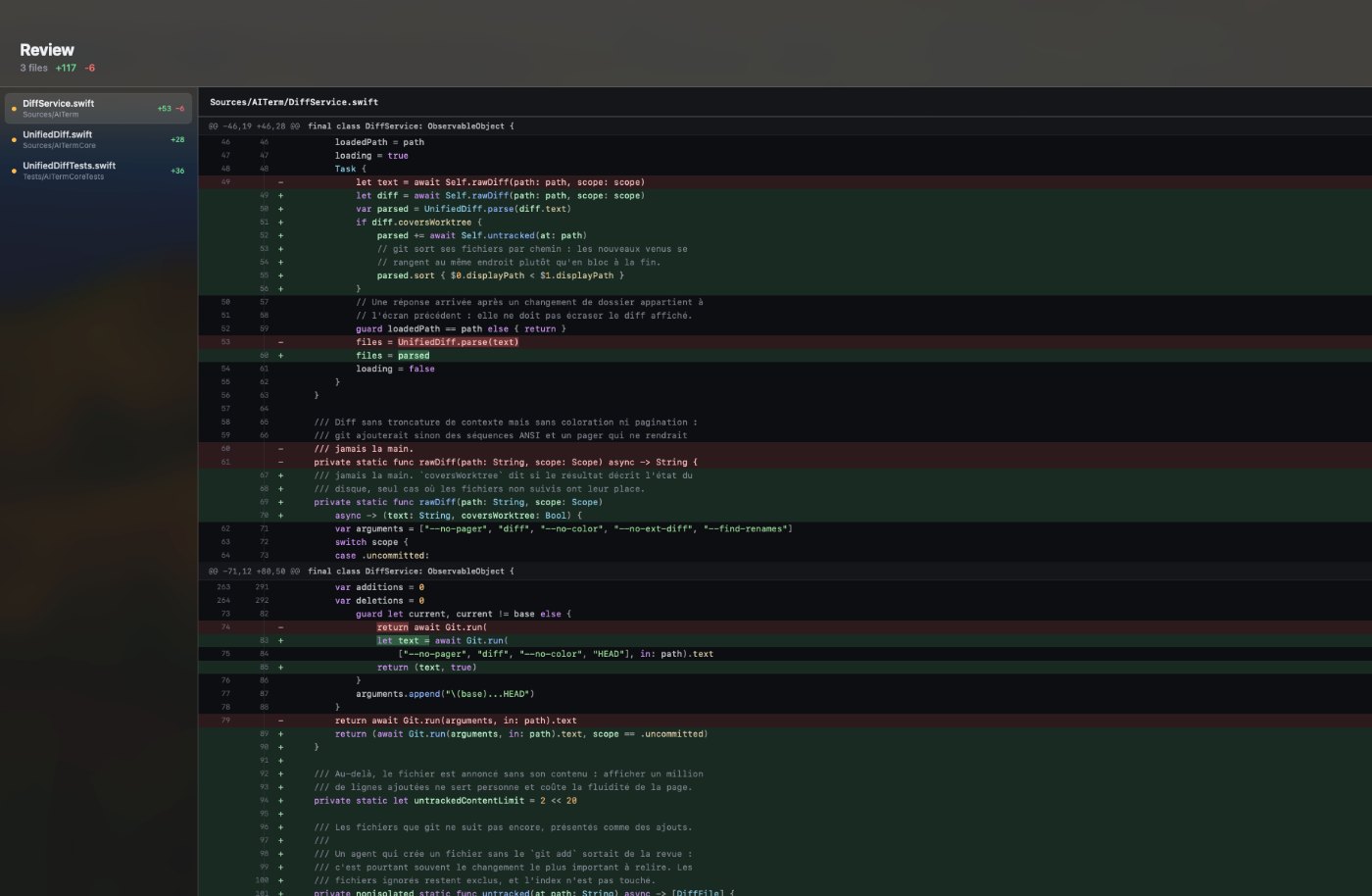
That is the friction we build against. Two agent sessions are trivial to start and annoying to watch, because the reviewer finishes silently while you are reading the author's output, and a review nobody reads is worse than no review. AITerm shows a live state per agent session, so needs attention is a color in your peripheral vision rather than a tab you remember to check. Same idea as running isolated worktrees for parallel agents, applied to the smallest possible fleet: two.
The short version: if you are going to take one thing from this article into your setup tomorrow, make it the second pane, not the subscription tier.
Going further
GUIDE
Claude Code like a power user
The session fundamentals worth having before you automate anything, CLAUDE.md included.
WORKTREES
Six worktrees, only four paid off
How to isolate the author and the reviewer so they never fight over your working tree.
AGENTS
Agent teams are not pointless
What happens when the review crew grows past two, measured in RAM and tokens.
COMPARISON
Codex vs Claude Code, both daily
Picking the second model for cross-review, and where each one actually reads better.
PRODUCT
Two agents, one screen
Native panes with a live state per agent session, so a finished review never waits unread.
Sources
- Code Review, Claude Code documentation, 2026: research preview status and Team and Enterprise availability, the parallel agent fleet and verification step, the three severity levels, the neutral check run conclusion and the
bughunter-severityJSON, the three review triggers, the July 2026 change to@claude review, fork pull request handling,CLAUDE.mdandREVIEW.mdcustomization, the 15 to 25 dollar average and 20 minute completion time, spend caps, and the local/code-reviewcommand with its effort levels and--fix,--commentand--postflags. - Claude Code GitHub Actions, Claude Code documentation, 2026:
/install-github-appquick setup, interactive against automation mode, the code review workflow withplugin_marketplaces,pluginsand theclaude_argsallowlist, the GitHub App permission set, secrets withheld from fork pull requests on public repositories, and the cost levers including--max-turns. - code-review plugin, anthropics/claude-code repository, 2026: the four parallel agents and what each one audits, the 0 to 100 confidence score, the threshold of 80, and the skip conditions for closed, draft, trivial or already-reviewed pull requests.
- 2025 Developer Survey, AI section, Stack Overflow, 2025: 84% of developers using or planning to use AI tools against 76% the previous year, distrust of output accuracy rising from 31% to 46%, 3% reporting high trust, and 66% naming "almost right, but not quite" as their biggest frustration.
- Trust in AI at an all time low, Stack Overflow press release, 2025: the same trust figures stated by the publisher.
- AI Code Review Only Catches Half of Your Bugs, O'Reilly Radar, 2026: the argument that roughly half of security defects are intent violations invisible without a specification, and the NIST SATE finding that the best static analysis tools plateau around 50 to 60% detection on security vulnerabilities.
- LLM Evaluators Recognize and Favor Their Own Generations, Panickssery, Bowman and Feng, NeurIPS 2024: frontier models distinguish their own output from other models' and humans' at non-trivial accuracy, and self-recognition capability correlates with the strength of self-preference.
- Do LLM Evaluators Prefer Themselves for a Reason?, arXiv, 2025: much of the self-preference of stronger models is legitimate, while the harmful residue concentrates where the evaluator model itself errs as a generator.
- Set up Code Review for Claude Code, Anthropic Help Center, 2026: setup flow for organization Owners, and the figure that fewer than 1% of findings are marked incorrect by the engineers reading them.
Frequently asked questions
What is Claude Code review?
It covers two different things that share a name. The local /code-review command runs inside an ordinary Claude Code session, reviews your branch's commits ahead of upstream plus your uncommitted changes, and reports correctness bugs along with reuse and simplification cleanups. The managed Code Review service is a GitHub App that reviews pull requests on Anthropic's infrastructure and posts findings as inline comments tagged by severity. The local command works on any plan that includes Claude Code. The managed service is a research preview limited to Team and Enterprise.
Is Claude Code review free?
The local /code-review command has no separate price: it consumes your normal Claude Code usage, so it is included with a Pro, Max, Team or Enterprise subscription and costs nothing extra beyond the tokens it burns. The managed GitHub service is not included in a plan's usage. Anthropic bills it separately through usage credits at an average of 15 to 25 dollars per review. The cloud ultrareview sits in between: Pro and Max subscribers get three free runs, then it bills per run.
How do I set up Claude Code review on GitHub?
There are two paths. For the managed service, an Owner enables Code Review at claude.ai/admin-settings/claude-code, installs the Claude GitHub App, picks the repositories, and sets a review trigger per repository: once after PR creation, after every push, or manual. For the self-hosted path, run /install-github-app from Claude Code and select the review workflow, or copy a workflow that calls anthropics/claude-code-action@v1 with the code-review plugin into .github/workflows/. The self-hosted path runs on your GitHub Actions minutes and your own API key or OAuth token.
How much does Claude Code Review cost per pull request?
Anthropic's documentation puts the managed service at 15 to 25 dollars per review on average, scaling with pull request size, codebase complexity, and how many candidate findings need verification. Reviews complete in about 20 minutes. The trigger multiplies that: once per PR bills once, while reviewing on every push bills once per push. You can cap monthly spend for the Claude Code Review service at claude.ai/admin-settings/usage, and the admin table shows an average cost per review per repository.
Is Claude good at reviewing code?
It is good at correctness bugs that are visible in the diff and its surrounding code: races, unhandled edge cases, silent failure paths, unscoped queries. Anthropic reports that fewer than 1% of the managed service's findings get marked incorrect by engineers. Across 62 of our own merged pull requests, agent review posted 148 findings, we changed code for 51 of them, and 9 were bugs that would have shipped. Where it stays weak is intent: a diff that is internally correct but does the wrong thing. That gap is structural, not a tuning problem.
What is the difference between /code-review and the Code Review GitHub App?
Scope, billing and configuration. The command reviews your working tree before you push, runs as a background subagent with its own context window, reads your CLAUDE.md but not REVIEW.md, and can apply its own findings with --fix or post them with --comment. The GitHub App reviews the pull request after you push, runs a fleet of agents on Anthropic infrastructure with a verification pass, reads both CLAUDE.md and REVIEW.md, tags findings by severity, and writes a Claude Code Review check run that always completes neutral so it never blocks a merge.
Can Claude Code review its own code?
It can, and it does by default, which is the part worth thinking about. Panickssery and co-authors showed at NeurIPS 2024 that LLM evaluators recognize their own generations and favor them, and follow-up work in 2025 found the harmful part of that bias concentrates exactly where the evaluator was wrong as a generator. In practice the fix is cheap: have a different model read the diff. We run Claude Code in one pane and Codex in another, and across our last 18 pull requests the two agents agreed on only about a quarter of their findings.
Does Claude review pull requests from forks?
Not automatically, whatever trigger the repository is set to. Someone with write, maintain or admin permission on the base repository has to comment @claude review as a top-level comment on the pull request. Pushing new commits to a fork PR starts nothing, and clicking Re-run on the check run starts nothing either. On the self-hosted GitHub Actions path the constraint is different but has the same effect: on public repositories GitHub withholds secrets from workflow runs triggered by fork pull requests, so the review only runs on branches in the same repository.